My City My Responsibility
A Handbook for Active Citizenship
By Janaagraha · Published November 2023 · Foreword by Shri Hardeep Singh Puri, Minister of Housing and Urban Affairs
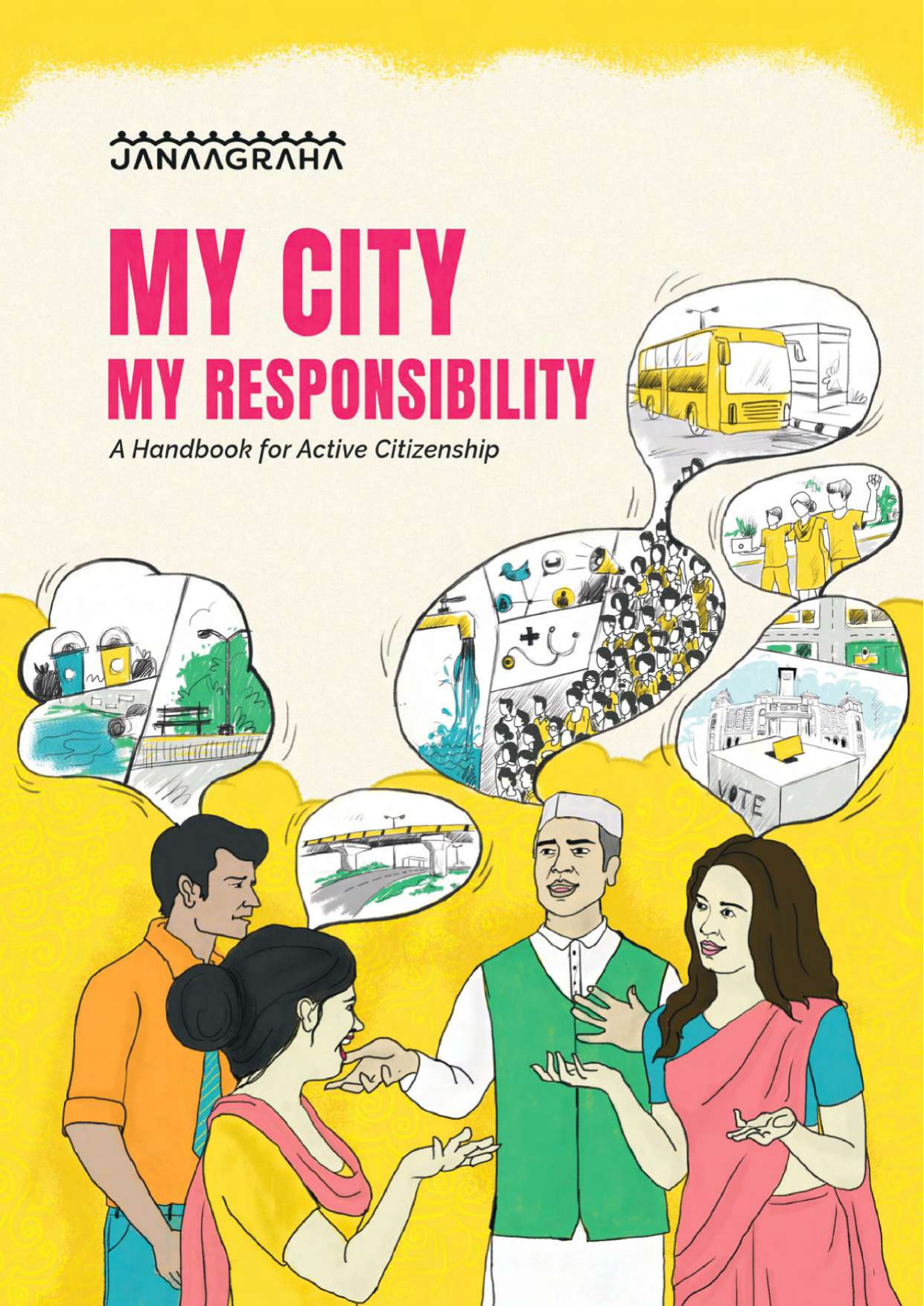
Cover illustration from the Janaagraha handbook — Citizens discussing transportation, public health, governance, voting, and urban infrastructure.
Table of Contents
Foreword
Shri Hardeep Singh Puri
Hon'ble Minister of Housing and Urban Affairs, Government of India
"My City My Responsibility — A Handbook for Active Citizenship" is a timely resource for civil society, interested citizens, and public-spirited endeavours who wish to learn about and contribute more to the development of their cities.
India's urban areas are the key to its development in this period of "Amrit Kaal". The concept of Jan Bhagidari — participation of citizens in governance — is now an integral aspect of many national movements, including flagship government missions such as Swachh Bharat Mission, Pradhan Mantri Awas Yojana, Smart Cities Mission and AMRUT.
This handbook draws guidance from the same well as it provides advice and insight to city dwellers and enables them to engage meaningfully with their local government. When citizens, officials and councillors in more than 90,000 wards in 4,800 towns and cities team up together for local action, then even the mightiest of global challenges such as climate change, public health, gender equity, and services for the urban poor can be tackled.
01. Getting Started
1.1 Is this handbook for me?
This handbook is designed to be of use to everyone — regardless of experience and expertise. If you're eager to make your neighbourhood and your city a better place, this handbook is for you.
1.2 Why did we create this handbook?
This handbook equips citizens with the practical know-how they need to bring about the change they seek in their localities. It encourages an inclusive, bottom-up approach to city planning and development that promotes — and improves — participatory democracy at every level of governance.
1.3 Types of Citizens
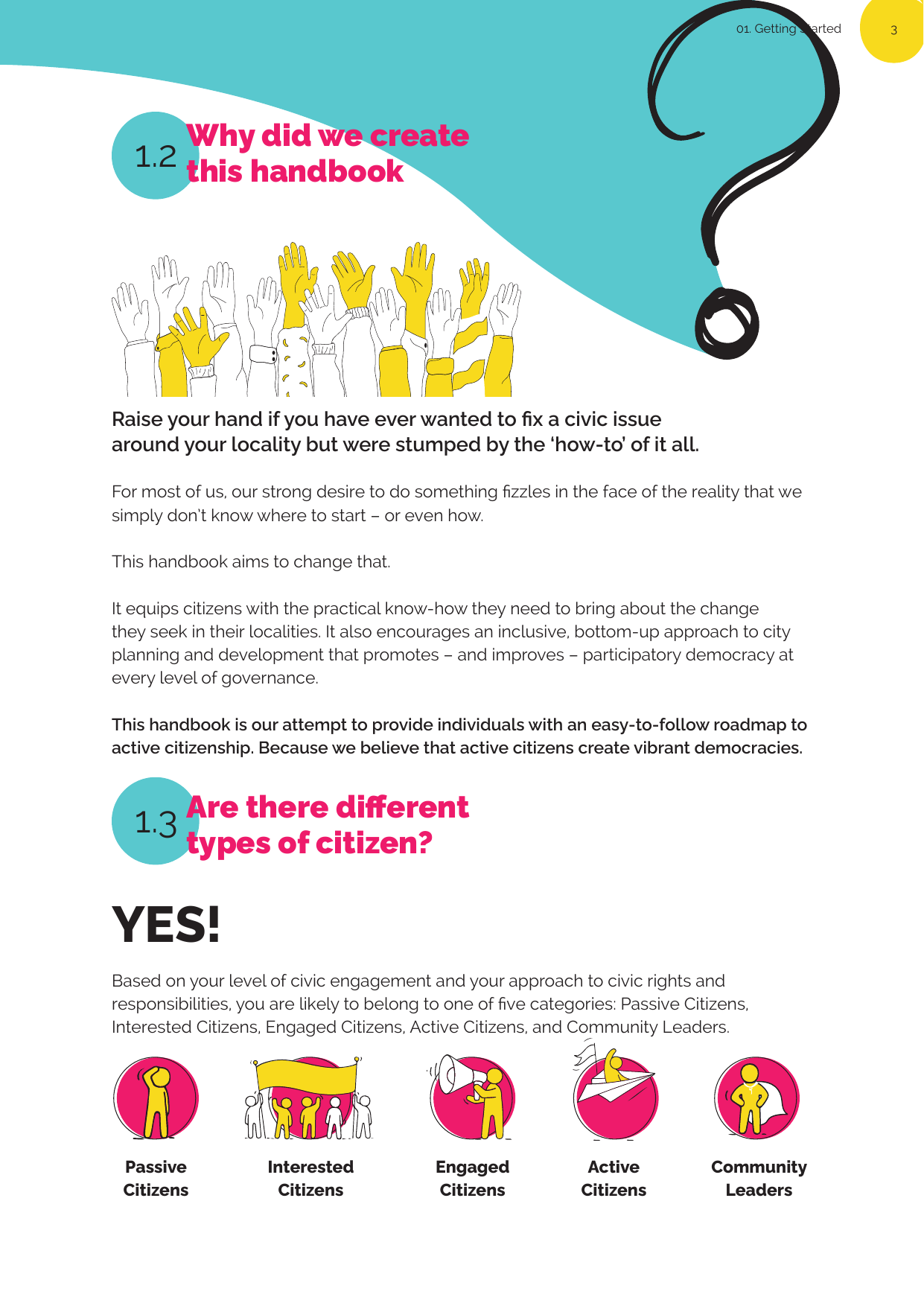
The five types of citizens by level of civic engagement — from passive to community leader. (Source: Janaagraha)
Based on your level of civic engagement, you likely belong to one of five categories:
- Passive Citizens — Irritated by civic issues but believe not much can change
- Interested Citizens — Want to do something but don't know how or where to start
- Engaged Citizens — Modestly involved in neighbourhood issues through RWAs
- Active Citizens — Actively engage in civic issues on a regular basis
- Community Leaders — Mobilise citizens and set agenda for collective action
It is important to remember that every Active Citizen was probably a Passive Citizen at some point. Where you are today does not permanently define the kind of citizen you can be.
1.4 How can being an active citizen help the country?
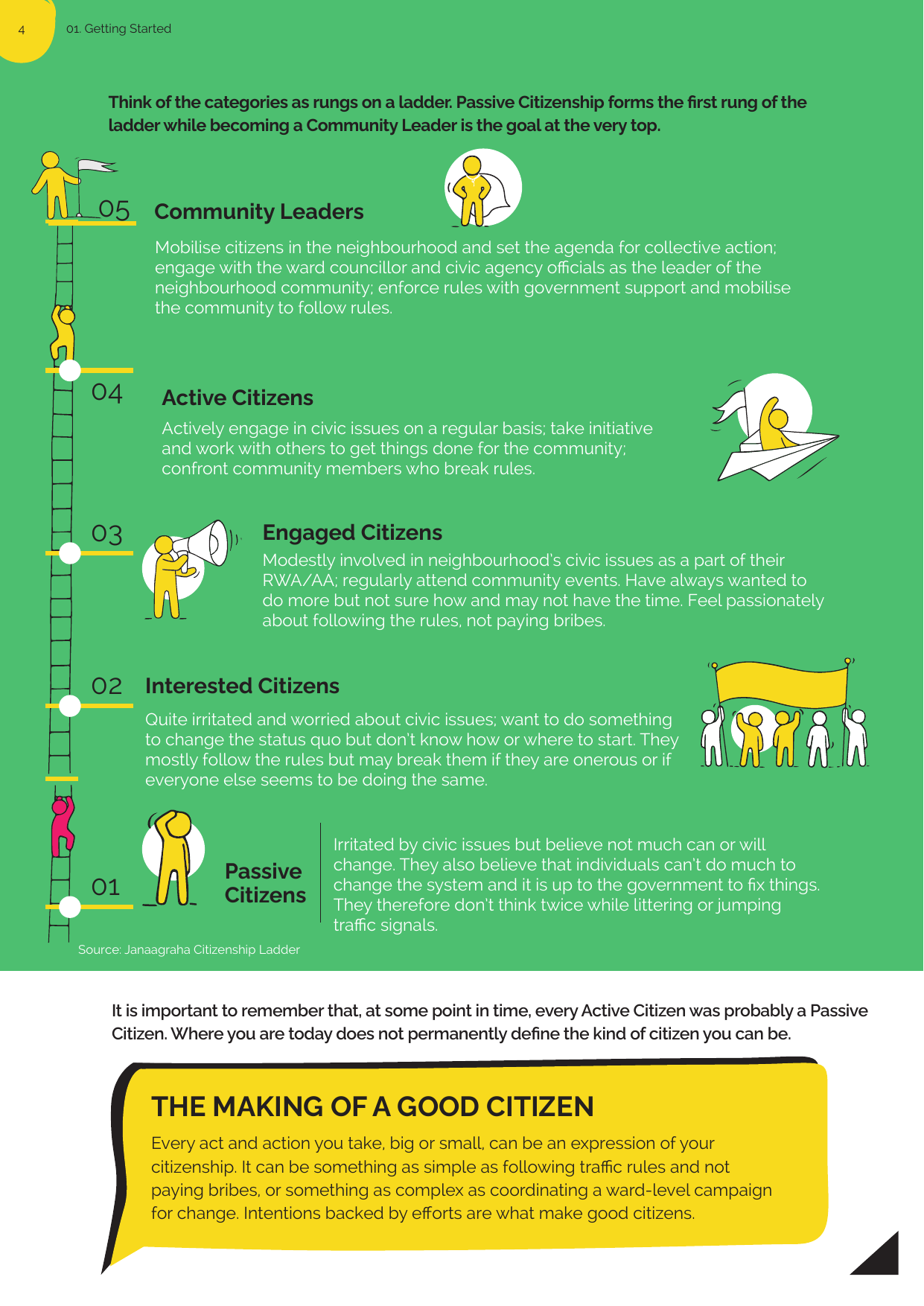
The Citizenship Ladder — visualising the journey from passive citizen to community leader. (Source: Janaagraha)
Active citizens use their nuanced knowledge of their localities to highlight neighbourhood-specific issues. They channel their understanding of the community's needs to develop specific solutions. They push for city budgets to reflect the concerns and aspirations of their locality more accurately.
Active citizens are also best placed to adopt a local approach to the global problem of climate change. After all, a greener, more environment-friendly neighbourhood translates into healthy citizens and healthy communities.
1.5 What can I expect to learn?
- Section 2 — Everything about how your city is managed
- Section 3 — Your ward, its governance, and its budget
- Section 4 — Different ways to engage with civic authorities
- Section 5 — Ward committees and how to get involved
- Section 6 — Taking your ward committee to the next level
Also included: How to conduct events, engage with media, draft letters, report issues, and use social media effectively.
02. Decoding City Governments
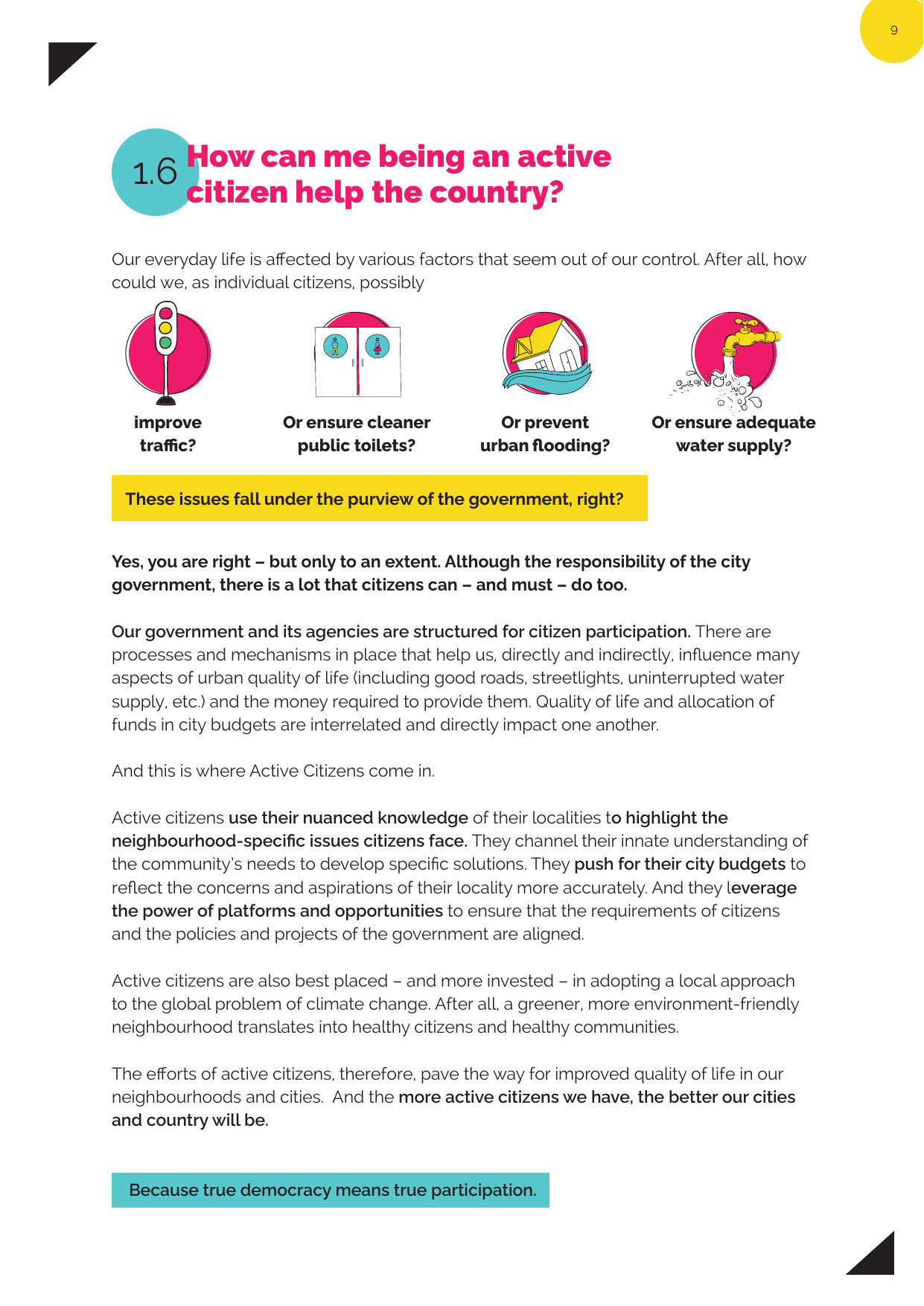
Civic issues that fall under city government purview — from traffic to water supply. (Source: Janaagraha)
2.1 How is my city administration structured?
After the central and state governments, city governments form the third level of governance. Large cities are typically divided into zones, which are further divided into wards. Each ward has an elected representative (councillor or corporator) and staff (engineers, health inspectors, etc.).
2.2 What is my city government responsible for?
City governments get their power from the 74th Constitutional Amendment Act (1993). The 12th Schedule lists the following functions:
- Urban planning including town planning
- Regulation of land use and construction of buildings
- Roads and bridges
- Water supply for domestic, industrial, and commercial purposes
- Public health, sanitation conservancy, and solid waste management
- Fire services
- Urban forestry and environmental protection
- Urban poverty alleviation
- Provision of urban amenities (parks, street lighting, parking lots)
- Slum improvement and upgradation
- Registration of births and deaths
- Regulation of slaughterhouses and tanneries
2.3 How is my city government structured?
Your city government comprises:
- Elected Wing (Political) — Headed by the mayor, consisting of the city council (all elected councillors) and standing committees for accounts, taxation, finance, public health, town planning, etc.
- Executive Wing — Headed by the commissioner (typically IAS/State Administrative Service), focusing on implementation with deputy commissioners, engineers, and municipal staff.
2.4 City Finances
A city has three main sources of income:
- Central Government — Finance Commission grants, schemes like AMRUT, Swachh Bharat, Smart Cities
- State Government — State Finance Commission grants, state-specific missions
- City Government's Own Revenue — Property tax, advertisement tax, profession tax, trade licenses, building permits, user fees, parking charges
The budget is typically prepared between November and February, approved by the city council between February and March.
03. Know Your Ward
3.1 What is a ward?
Every city is organised into municipal wards for administrative convenience. Each ward has an elected representative (councillor) and staff. Typically, in bigger cities, a ward has 10,000 to 50,000 residents.
3.2 Who is in charge of your ward?
Each ward is represented by a councillor (also known as corporator) who is elected during city elections. The councillor is assisted by a ward officer (municipal officer appointed by the city government). Common ward officials include:
- Councillor (head of the ward, represents you at city council)
- Ward Engineer
- Revenue Officer
- Health Officer
3.3 How to find your ward information
- Visit your city government's website (look for "Know Your Ward" section)
- Check the Local Government Directory at lgdirectory.gov.in
- Look at street signages in your neighbourhood
- Check property tax documents or ration card
- Ask at government offices or RWAs near your house
3.4 Ward Budgets
The ward budget is part of your city's budget book. In most cases, it's available on your city government's website. You can also contact the chief accounts officer or file an RTI for the same.
Once the city budget is passed, resources are allocated for different projects. The lifecycle typically involves: Payment codes allocated → Job codes created → Tenders called → Work orders issued → Contractors implement work → Contractors paid after inspection.
04. Active Citizenship and You
4.1 Using Municipal Grievance Redressal Platforms
Your city government may have grievance redressal platforms in the form of toll-free numbers, websites, or mobile apps. You can also use the Swachhata app to report sanitation and waste management issues.
Steps to report an issue:
- Identify your city's grievance redressal platform
- Create an account and log in
- Post your complaint with details and location
- Follow up with your ward engineer and councillor
- If unresolved, escalate to zonal commissioner
4.2 Using RWAs, CSOs and SHGs
You can locate Residential Welfare Associations (RWAs) and Self-Help Groups (SHGs) by:
- Contacting the ward office
- Internet searches (<RWA> + <Area Name> + <City Name>)
- Asking neighbours and other residents
- Checking city repositories of RWAs
If your area doesn't have an RWA, you can form one by joining hands with your neighbours.
4.3 Using Social Media
Use social media to find and connect with your city government. Write about your issue and tag relevant government authorities. Follow up on complaints through tweets and posts. If unresolved, escalate to higher-ranking officers or elected members.
4.4 Success Stories
MyCityMyBudget Bengaluru: In 2021-2022, Bengaluru's city government set aside Rs 120 crores for ward committees (Rs 60 lakhs per ward) in a big win for participatory budgeting.
Banaswadi Rising: Amith Nigli started with a WhatsApp group in Bengaluru's Ward #27. It grew to 14 WhatsApp groups with 250 members each, one for each block. Through ward committee meetings, they resolved park maintenance issues within two days.
4.5 Active Citizenship Pledge
I take the Active Citizenship Pledge.
I am a citizen of India and of the city I live in. I believe in democracy and the rule of law. I care deeply about my rights and duties, both to the government and to my fellow citizens.
I pledge to:
- Vote in all elections when I'm eligible
- Actively participate in civic matters in my neighbourhood
- Engage constructively with the government
- Care for and respect public spaces
- Not litter, dispose garbage responsibly, follow traffic rules
- Never pay bribes and pay taxes that are due
- Attend ward committee meetings and collaborate with the government
I pledge to be the change I want to see — in my neighbourhood, my city, and my country.
05. Ward Committees
5.1 Why are ward committees important?
Ward committees are considered the fourth tier of governance, ensuring "last mile" democracy. They are a place where citizens and officials come together; where individuals are given a say in the way neighbourhoods are managed and developed.
Ward committees help:
- Promote transparency and accountability
- Improve bottom-up planning and budgeting
- Prioritise decision making through participatory democracy
- Advocate local solutions for local problems
- Bring city governance to the doorstep of citizens
5.2 What areas does a ward committee oversee?
Ward committees serve as a space where citizens and local government can work together on issues of public infrastructure, solid waste management, sanitation, water, public health, and budget/revenue.
5.3 Success Story: Mrs Poongothai's Journey
Mrs Poongothai from Bengaluru faced the familiar dilemma: the desire to fix issues she saw every day but the lack of know-how. Through ward committee meetings, she and her neighbours have successfully addressed their ward's concerns, including the construction of a culvert in the drain on NICE Road.
06. Taking Action
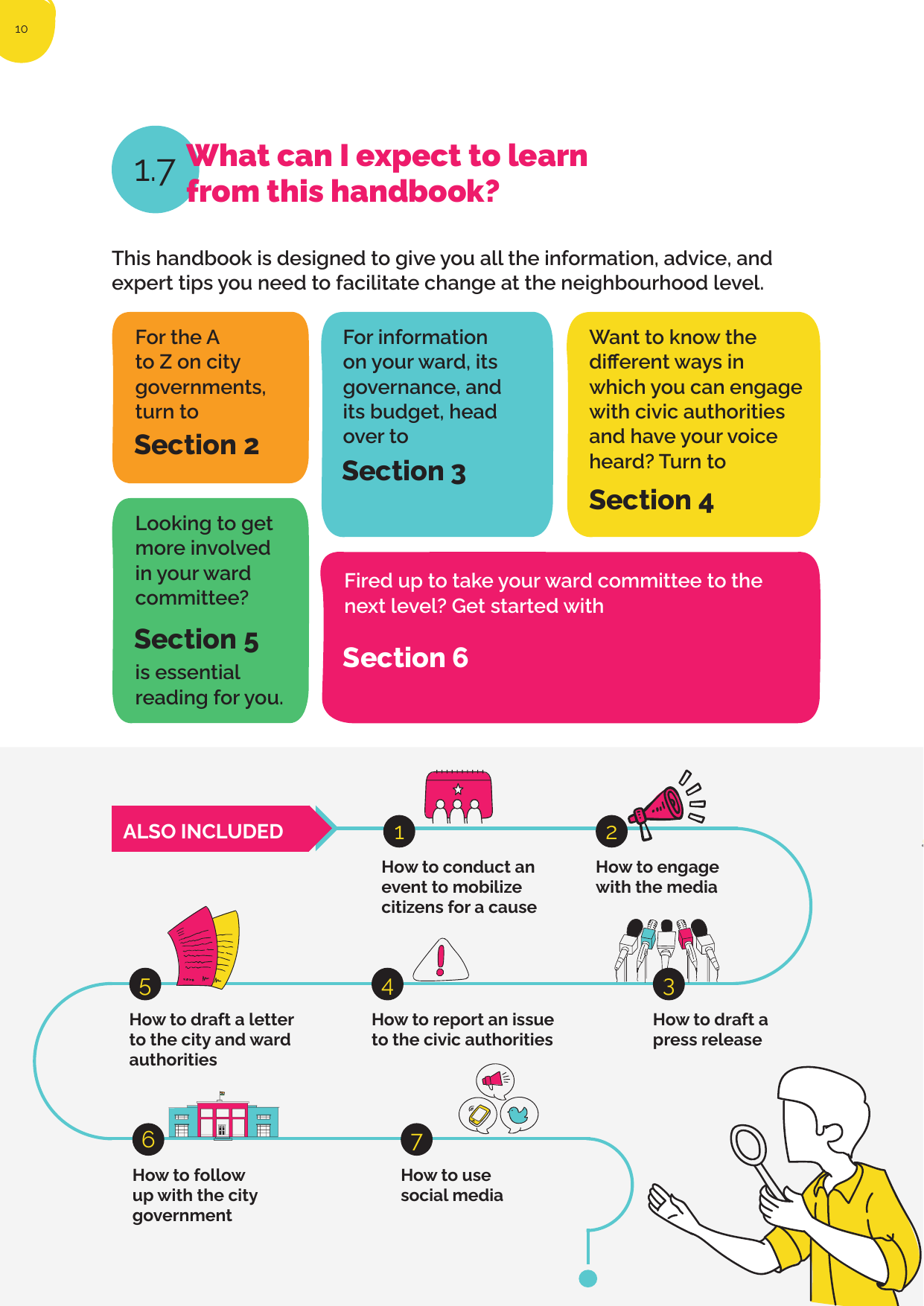
The active citizenship pathway — from mobilisation to media engagement, reporting issues, and following up with authorities. (Source: Janaagraha)
Creating Your Civic Directory
Set up a civic directory with all necessary details of your ward:
- Ward Number and Name
- Name of Councillor and Contact information
- Name of Ward Engineer and Contact information
- Name of Zonal Commissioner and Contact information
- Name of Health/Sanitation Officers
- Address of Ward Office
- Budget allocated to the ward
- Ongoing or completed civic works
- Issues that should be prioritized
How to Report an Issue
- Identify the specific issue and location
- Find the correct authority (ward engineer, councillor, or specific department)
- Use the appropriate channel (grievance portal, email, phone, social media, or in-person meeting)
- Document your complaint with photos and details
- Follow up regularly and keep records
- If unresolved, escalate to higher authorities
Engaging with Media
- Draft a clear, concise press release with facts and quotes
- Contact local journalists and news editors
- Use social media to amplify your message
- Organize press conferences or media briefings for larger issues
About Janaagraha
Janaagraha has worked extensively towards nurturing active citizenship and participatory democracy for more than 20 years. Their goal is to transform the quality of life in India's cities and towns by catalysing active citizenship and reforming city governance.
Key programmes include:
- MyCityMyBudget — Participatory budgeting campaign in partnership with city governments
- Annual Survey of India's City-Systems (ASICS) — Evaluating quality of city governance
- Ward Committee Strengthening — Working across cities to make ward committees effective
For more information: [email protected]
Download the Full Handbook
This page is a summary. For the complete handbook with all exercises, quizzes, templates, and detailed guides:
Download PDF (20 pages)