What if the fundamental building blocks of the universe aren't particles at all, but patterns of twisting? What if an electron and a neutrino are just different ways of tying the same knot? This is the radical premise of Sundance Bilson-Thompson's braid model[1] — and it's one of the most elegant ideas in modern particle physics that almost nobody talks about.
Ribbons, Not Particles
The standard model gives us a zoo of particles: quarks, leptons, bosons, each with their own charges, spins, and interactions. But it doesn't explain why there are three generations of matter, or why the charges take the values they do. The quantum numbers feel arbitrary — imposed from experiment rather than derived from first principles.
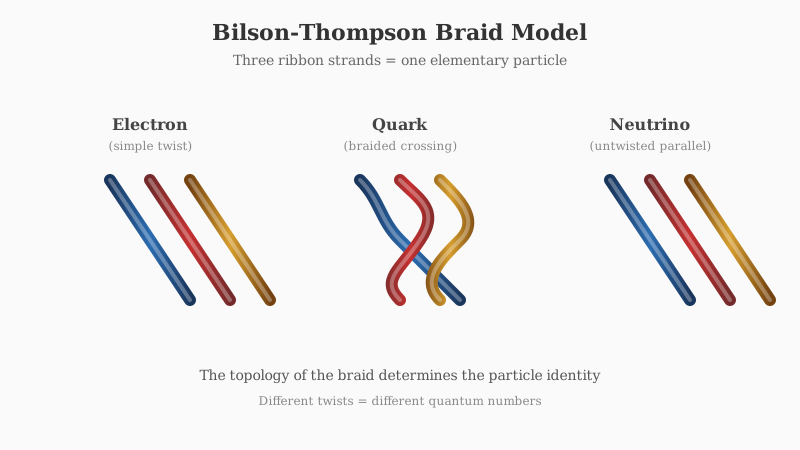
Bilson-Thompson's model, published in 2005[1], takes a different approach. Instead of treating particles as irreducible points, it posits that everything is built from a single kind of entity: a "preon" represented as a ribbon. Three such ribbons can be braided together, and the topology of the braid — how the strands twist and cross — determines the particle's properties.
The first generation of standard model fermions (electron, neutrino, up and down quarks) emerge naturally from simple braiding patterns. Each twist contributes to quantum numbers like charge and hypercharge. The model even reproduces the correct fractional charges of quarks without postulating them by hand. Later work with Fotini Markopoulou and Lee Smolin extended the model and connected it more tightly to loop quantum gravity[2].
Braiding and the Quantum Hall Effect
Here's where it gets genuinely interesting. The braid model isn't just a particle physics curiosity — it connects directly to one of the most robust phenomena in condensed matter physics: the fractional quantum Hall effect (FQHE).
In the FQHE, electrons confined to a two-dimensional plane in a strong magnetic field behave collectively as "quasiparticles" with fractional charge. These quasiparticles are anyons — particles whose quantum statistics are intermediate between bosons and fermions. When you exchange two anyons, their wavefunction doesn't just pick up a +1 or −1 phase; it picks up a complex phase that depends on the path of the exchange.
This path-dependence is the signature of braiding. Anyons are literally braided around each other in the plane, and the braid group governs their statistics. The Bilson-Thompson model uses the same mathematical structure — the braid group on three strands — to classify elementary particles. The parallel is not coincidental; it's structural.
In the quantum Hall effect, flux attachment binds magnetic flux to electrons, creating composite particles that braid. In the Bilson-Thompson model, preon ribbons twist through a preon substrate, and the topology of their braiding determines the emergent particle identity. Both systems say the same thing: the topology of the exchange is the physics.
Topological Quantum Computation
This braiding property isn't just mathematically elegant — it's computationally powerful. In topological quantum computation (TQC), quantum information is stored in the braiding of anyons rather than in individual qubits. Because the information is encoded in global topological properties, it's inherently robust against local perturbations and noise.
As John Preskill explained in his seminal notes, braiding anyons generates unitary transformations on the quantum state space[4]. Specific braiding operations can implement quantum gates. The computation is performed by physically moving anyons around each other in a 2D material, and the resulting unitary depends only on the topological class of the braid — not on the precise path.
The Bilson-Thompson model suggests that this same topological machinery might operate at the most fundamental level of matter. If particles are braids, then quantum computation isn't just something we engineer in exotic materials; it's intrinsic to the structure of reality.
Why This Matters for Quantum Gravity
Loop quantum gravity (LQG) also uses topological structures — spin networks and spin foams — to describe the quantum geometry of spacetime. In LQG, area and volume are quantized, and the fundamental excitations are one-dimensional (like the edges of a spin network) rather than point-like. The theory is naturally background-independent and diffeomorphism-invariant.
The Bilson-Thompson model slots into this framework remarkably well. If preons are ribbon-like entities embedded in a quantum geometric substrate, then particle braiding and spacetime geometry share a common mathematical language. The braids that make particles are the same kind of topological objects that make space in LQG[2].
This convergence suggests a unified picture: the quantum geometry of spacetime is not a separate layer from the quantum structure of matter. They are the same structure, viewed from different scales. Particles are braids in the fabric of space itself.
The Objections
No honest treatment of this model can skip the problems. The Bilson-Thompson model does not yet predict particle masses, which is a major deficiency. The three generations of standard model fermions are accommodated but not explained — the second and third generations require more complex braids, but the model doesn't predict why there are exactly three. And while the braiding topology gives the correct quantum numbers, it doesn't automatically yield the dynamics of the standard model gauge interactions.
These are serious gaps. But they are gaps in a program, not refutations of an idea. The standard model itself had gaps for decades before electroweak unification and QCD completed the picture. The question is whether the braid framework is rich enough to eventually close them.
A Connection Worth Preserving
There's something deeply compelling about the idea that the most elementary structures in the universe are not material things but relationships — patterns of connection and twisting. The Bilson-Thompson model doesn't just give us a new way to classify particles; it gives us a new ontology. Matter is not made of stuff. It's made of topology.
The connection to the quantum Hall effect and topological quantum computation makes this more than philosophy. It means the same mathematical structures govern the fractional charges in semiconductor heterostructures, the quantum gates in topological computers, and — if the model is right — the elementary particles themselves. The universe, it seems, is a single topological computation, running at every scale.
Whether this picture survives experimental scrutiny remains to be seen. But as a framework for thinking about the unity of matter, space, and information, it is unparalleled in its elegance. And elegance, in theoretical physics, is never a guarantee — but it is always a compass.
References
- [1] Bilson-Thompson, S. O. (2005). A topological model of composite preons. [arXiv:hep-th/0503213]
- [2] Bilson-Thompson, S. O., Markopoulou, F., & Smolin, L. (2007). Quantum gravity and the standard model. [arXiv:hep-th/0603022]
- [3] Bilson-Thompson, S. O., & Vaid, D. (2016). LQG for the Bewildered. Springer.
- [4] Preskill, J. (1997). Fault-tolerant quantum computation. [arXiv:quant-ph/9712048]