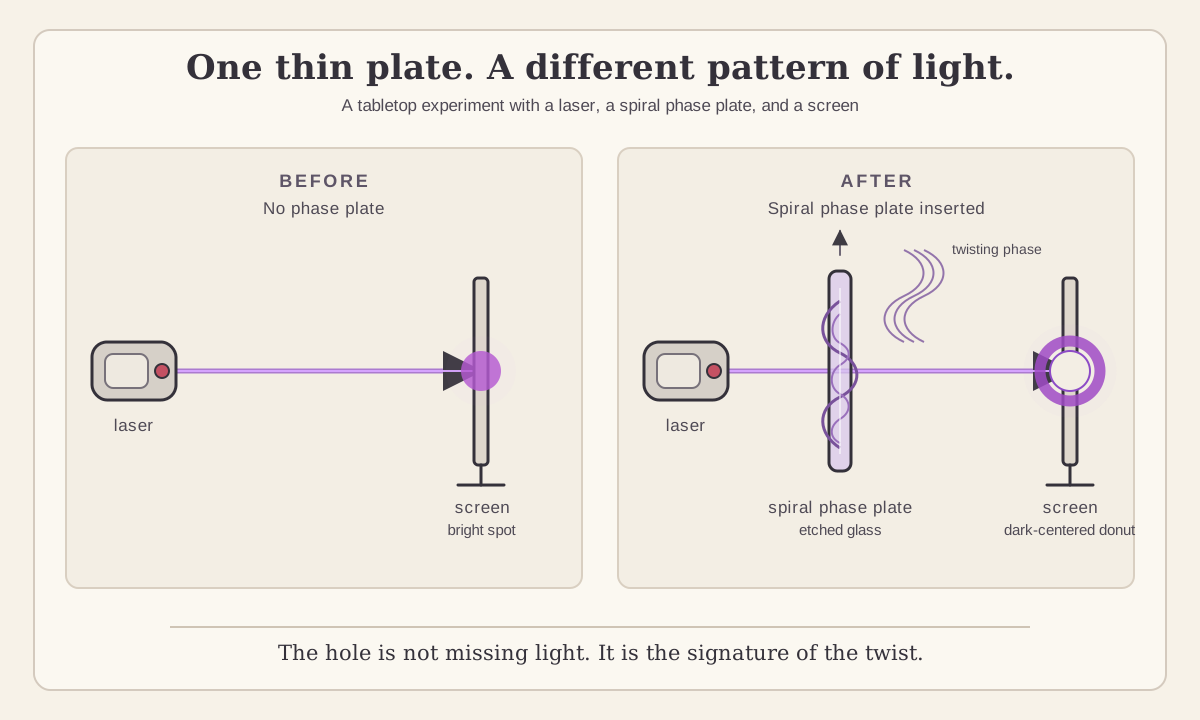
Turn off the lights. Shine a laser pointer at the wall. You see a bright, tight spot—a disk of light so ordinary that your brain edits it out before you even notice. Now slide a thin, transparent spiral plate into the beam, something no more exotic than a customized piece of etched glass. The spot vanishes. In its place appears a perfect dark ring, a donut of shadow surrounded by a faint glowing halo. The photons passing through that plate have not been absorbed, scattered, or lost. They have been twisted.
This is not a parlor trick. The donut is the signature of orbital angular momentum (OAM), a topological property of light that has nothing to do with polarization, color, or intensity.[1] Each photon in that ring carries a discrete quantum of twist, labeled by an integer ℓ that can in principle be any whole number: 1, 2, 5, 100. The beam's phase front spirals around the axis like a corkscrew, and where the phase is undefined—at the center—the intensity must fall to zero. Hence the hole. What you are looking at is not an absence of light but a structural property of light, as real and measurable as its wavelength.
Here is the puzzle. A single photon can exist in a superposition of these twisting states: not just ℓ = 0 or 1, but a coherent blend of many winding numbers at once. In principle, the Hilbert space is infinite-dimensional. In practice, experimenters routinely prepare photons in superpositions of ten, twenty, or more OAM modes, each orthogonal to the others.[2] And yet the prevailing language of quantum information remains stubbornly binary. We speak of qubits—quantum bits—as if nature had issued a mandate that every quantum system must choose between 0 and 1. We build superconducting circuits with two energy levels, trap ions with two hyperfine states, and count the "size" of a quantum computer by its qubit count as if adding dimensions were merely a matter of adding transistors.
So the question this essay wants to hold steady is simple and uncomfortable: If a single photon can carry an unbounded topological label encoded in its spatial structure, why are we still building quantum information science as if the universe were digital?
The Accidental Tyranny of Two
The binary qubit is not a law of nature. It is a historical convenience with deep roots. Classical computing grew from relays and vacuum tubes that were either on or off. Quantum mechanics, when it entered information theory in the 1980s and 1990s, borrowed that framing because it was mathematically tractable and experimentally accessible. A photon's polarization offers two orthogonal states—horizontal and vertical, or left- and right-circular—that are easy to prepare with waveplates, easy to filter with polarizers, and easy to detect with standard photodiodes. Two states mapped neatly onto the classical bit, and a research program was born.
But there is nothing fundamental about two. The Schrödinger equation does not care whether your Hilbert space has dimension two or two hundred. A qudit—a d-level quantum system—evolves under the same linear rules as a qubit, and entanglement between qudits is every bit as quantum as entanglement between qubits. What changes is the information density. A pair of entangled qudits, each with dimension d, can violate Bell inequalities more strongly than qubits can, can carry log₂(d) bits of classical information per particle, and can offer enhanced security against eavesdropping in quantum key distribution.[3] The advantage is not speculative; it is information-theoretic and provable.
So why the resistance? Part of the answer is engineering culture. The transistor is the most successful technology in human history, and its logic is binary all the way down. Quantum computing, despite its radical physics, has inherited that cultural default. Qubit counts make headlines. Startups pitch "1000 qubit" roadmaps because the number resonates with investors trained on Moore's Law. A press release announcing "32 qudits of dimension 8" sounds arcane by comparison, even though the Hilbert space dimension—8³²—dwarfs that of 1000 qubits. We are, in a sense, victims of our own metaphor.
But I think there is something deeper than culture. The binary choice offers a kind of existential comfort. A qubit is decidable. It is either 0 or 1, up or down, dead or alive. Even in superposition, the measurement outcome is binary. The qubit fits our cognitive wiring: we are creatures that sort, classify, and reduce. A qudit, by contrast, is irreducibly plural. It demands that we hold multiple possibilities in tension without collapsing them. That is not how most human minds prefer to work. The qubit is not just easier to engineer; it is easier to think about. And that ease has disguised itself as physical necessity.
The Winding Staircase
Photonics offers the most natural escape from binary thinking because light itself is not binary. The OAM degree of freedom is only one of several spatial and temporal structures a photon can carry. Others include transverse momentum modes, time-bin encoding, and frequency-bin superpositions. Each defines a ladder of orthogonal states, and the ladder has no top rung in principle. In 2012, a team in Vienna demonstrated entanglement between photons differing by up to 600 units of orbital angular momentum—a Hilbert space large enough to make a qubit enthusiast weep.[4] Two years later, the same group generated a (100 × 100)-dimensional entangled state and verified it with a novel criterion that extracted the dimensionality without needing to reconstruct the entire state.[5]
These experiments matter not because they set records but because they reveal a conceptual landscape we have been slow to explore. The photon is not a point particle carrying a bit. It is a field configuration, extended in space and time, capable of topological complexity that no transistor can mimic. When we encode information in OAM, we are not "using more states" in the sense of a larger alphabet. We are using a different kind of state—one whose orthogonality is guaranteed by topology rather than by energy level spacing.
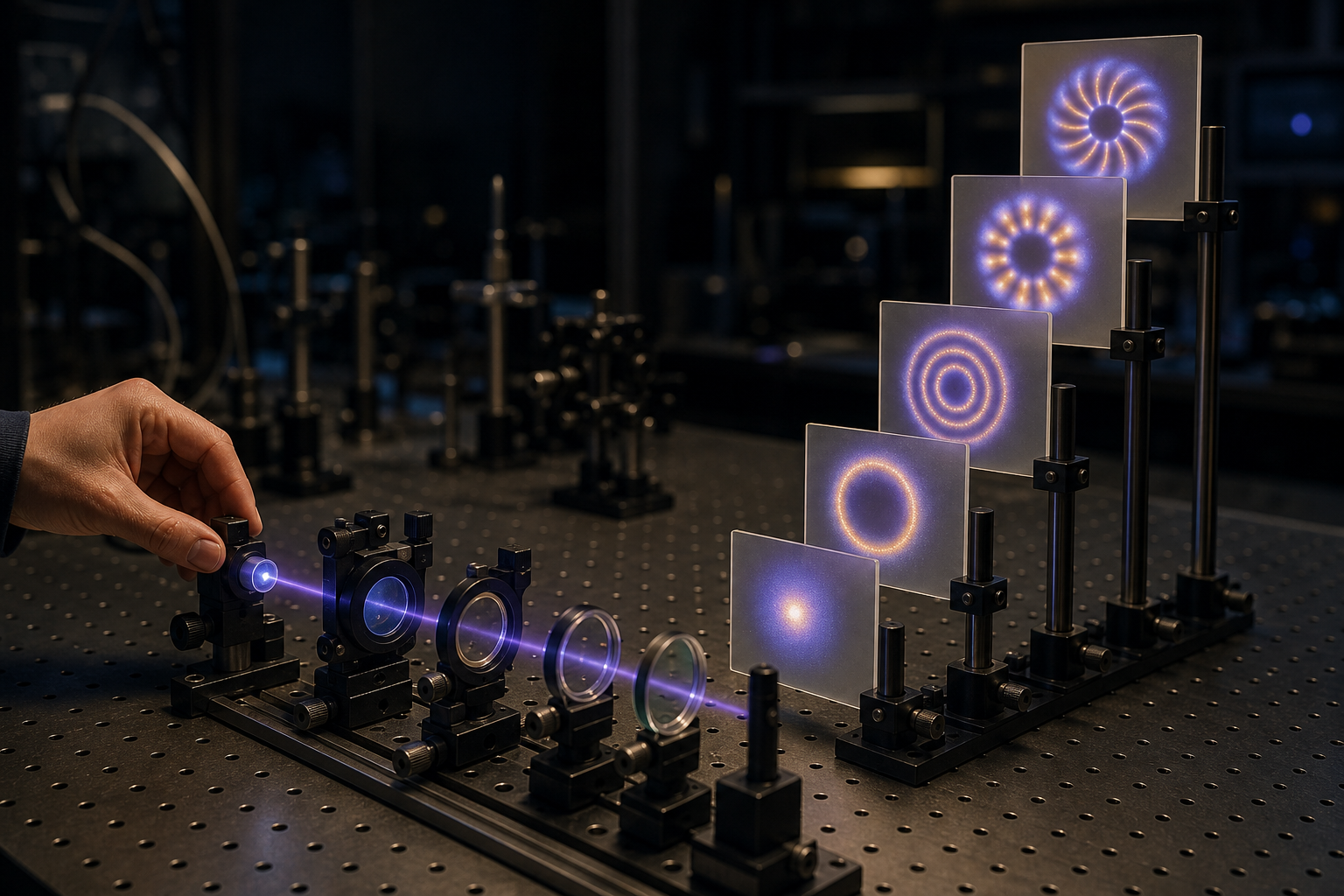
This topological guarantee is subtle. Two OAM modes with different ℓ values are orthogonal because their phase structures are fundamentally incompatible: one winds m times around the axis, the other n times, and no local operation at the beam center can transform one into the other. The orthogonality is global. It is the optical analogue of a knot invariant—you cannot untie the difference by small deformations.
The Fragility of Topology
And yet—the very globality that makes OAM attractive also makes it fragile. Send a twisted photon through turbulent air, and atmospheric density fluctuations scramble the phase front. The beautiful donut on your laboratory wall distorts into a speckled mess. The orthogonality that was topological in free space becomes approximate in a noisy channel. Fibers help, but standard single-mode fibers strip OAM because they are designed to do exactly that: guide only the fundamental Gaussian mode. Special multi-mode or ring-core fibers can preserve OAM, but they are harder to manufacture and splice.[6]
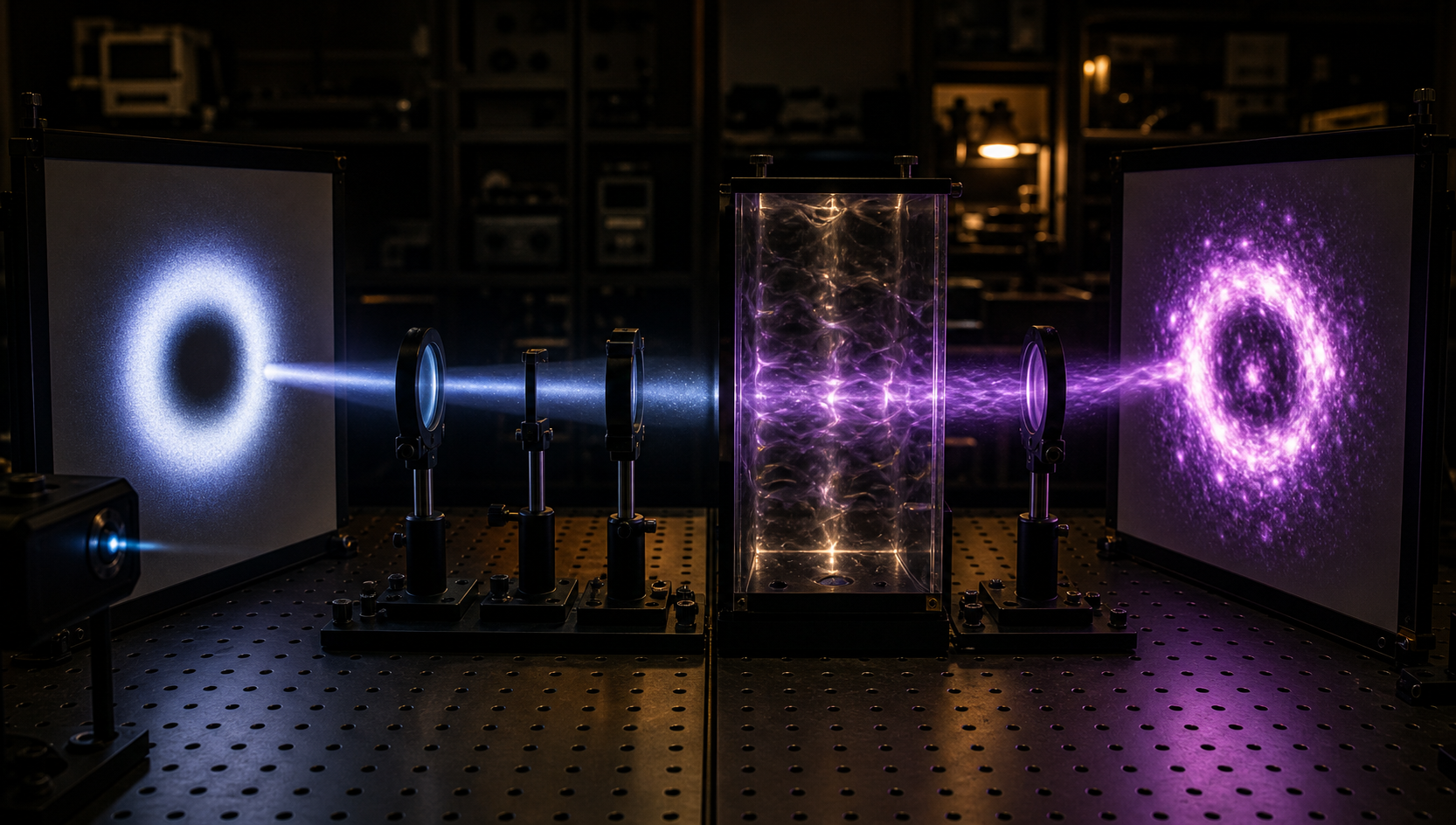
Crosstalk is the enemy. In a qubit system, a bit-flip error moves your state from |0⟩ to |1⟩. In a qudit system, a small perturbation can smear your state across all d levels simultaneously. The error landscape is richer and more treacherous. This is why quantum error correction for qudits is harder to visualize and harder to implement than the familiar surface code, though theoretical frameworks do exist.
There is also the detection problem. A polarizing beam splitter cleanly separates |H⟩ and |V⟩. Sorting OAM modes requires more elaborate optics—spiral phase plates, holograms, or interferometric networks—and the efficiency drops as the dimension grows. You cannot simply "read out" a qudit the way you read a bit. You perform a projective measurement onto a chosen basis, and if you chose wrong, the information is lost.
What the Ladder Costs
If the engineering is harder, what compensates? The honest answer is: it depends on whether you are trying to compute or to communicate. These are different tasks with different constraints, and the qudit advantage is not evenly distributed between them.
Consider computation first. The theorists have shown that certain algorithms run more efficiently on qudits. The quantum Fourier transform needs fewer gates. Magic state distillation—the expensive bottleneck of fault-tolerant computing—can be more efficient in higher dimensions.[3] But here is the catch: these are asymptotic advantages. They assume you can build the gates, control the phases, and correct the errors with the same precision that qubit systems enjoy. In practice, no one has done this. The surface code—the nearest-neighbor, two-dimensional error-correcting fabric that has consumed thousands of research hours—does not translate neatly to qudits. The control electronics become more complex. The cryogenics do not care about your Hilbert space dimension; they care about heat load and wiring density. For computation inside a cryostat, qubits have a head start measured in decades.
Now consider communication. Here the photon is already the only viable carrier for long-distance quantum links, and its native dimensionality is not a complication to be engineered around but a resource to be harvested. A photonic qudit channel carries more secure bits per photon than a qubit channel. In quantum key distribution, high-dimensional states tolerate higher noise thresholds before security is compromised. An eavesdropper trying to clone a qudit faces the no-cloning theorem in a harsher form: the fidelity of any approximate clone decreases as the dimension increases.[6] The security is not marginally better; it is structurally better, bounded by the Hilbert space dimension itself.
There is a subtler gain too. Certain distributed computing tasks require less classical communication when parties share entangled qudits rather than qubits. The photon becomes not merely a messenger but a compressed packet of correlation. Its spatial structure determines how much correlation it can carry, and that structure is already there, waiting, every time a laser turns on.
So the ladder is not free. It costs in fragility, in measurement complexity, in control electronics. But in communication—where photons already reign—it offers something closer to a native advantage than an engineered workaround.
The Ladder or the Wall?
This brings us to the deeper question the essay has been circling. Is the qudit a stepping stone—a temporary ladder we climb on the way to some future technology that will make dimensional encoding irrelevant—or is it a permanent feature of how quantum information must be handled?
The stepping-stone view says: eventually we will build fault-tolerant quantum computers with enough physical qubits that encoding multiple bits per particle is unnecessary. Why complicate matters when you can simply add more qubits? This is the surface-code orthodoxy. The surface code is beautifully understood, requires only nearest-neighbor interactions, and tolerates error rates around 1%. If you can build a million physical qubits, you do not need qudits. You just need redundancy.
The permanent-feature view says: nature does not respect our architectural preferences. Photons are high-dimensional whether we like it or not. The vacuum supports infinitely many modes per momentum; restricting ourselves to two is like building a railway network and only using one track. Yes, the engineering is harder, but the physics is richer. And in communication—where photons are already the only viable carrier for long-distance quantum links—ignoring their native dimensionality is like refusing to use the bandwidth you have been given.
I think both views are partially true and that the tension between them is productive. For computation inside a cryostat, qubits will likely dominate for the foreseeable future because the control and error-correction infrastructure is so much further along. For communication through free space or fiber, qudits are not an alternative future but an emerging present. The two domains may converge, or they may remain distinct. Either way, the binary assumption is no longer innocent. It is a choice, and like all choices, it has costs.
The Hole at the Center
Let me return to the donut. There is something philosophically strange about that dark center. It is a region where the light field is mathematically present—the wavefunction is non-zero nearby—yet the intensity vanishes because the phases from all directions cancel perfectly. The hole is not an obstruction; it is a consequence of global coherence. Destroy the coherence—introduce a little turbulence, a slight misalignment—and the hole fills in. The donut becomes a spot again, degraded and ordinary.
The qudit is like that donut. Its high-dimensional structure is visible only when the global coherence is preserved. A qubit is robust in the sense that it takes a strong perturbation to flip it. A qudit is fragile in a different sense: it takes only a weak perturbation to blur its fine structure across many levels. But when the coherence holds, the structure contains more.
This, I think, is why photonic qudits matter beyond their technical specifications. They force us to ask what we mean by "a quantum state." Is it a minimal unit of information, optimized for control and error correction? Or is it a physical degree of freedom, as rich as the medium allows? The laser pointer on the wall does not care about our conventions. It simply carries twist, and the amount of twist is limited only by the aperture of our instruments and the steadiness of our hands.
The binary world was a simplifying assumption that served us well. It gave us classical computing, digital communication, and the first generation of quantum devices. But light was never binary. It was always a winding staircase, and we are only now learning to climb.
References
- [1] L. Allen, M. W. Beijersbergen, R. J. C. Spreeuw, and J. P. Woerdman, "Orbital angular momentum of light and the transformation of Laguerre-Gaussian laser modes," Phys. Rev. A 45, 8185 (1992). DOI: 10.1103/PhysRevA.45.8185
- [2] A. Mair, A. Vaziri, G. Weihs, and A. Zeilinger, "Entanglement of the orbital angular momentum states of photons," Nature 412, 313 (2001). DOI: 10.1038/35085529
- [3] M. Erhard, M. Krenn, and A. Zeilinger, "Advances in high-dimensional quantum entanglement," Nature Reviews Physics 2, 365 (2020). DOI: 10.1038/s42254-020-0193-5
- [4] R. Fickler et al., "Quantum entanglement of high angular momenta," Science 338, 640 (2012). DOI: 10.1126/science.1227193
- [5] M. Krenn et al., "Generation and confirmation of a (100 × 100)-dimensional entangled quantum system," PNAS 111, 6243 (2014). DOI: 10.1073/pnas.1402365111
- [6] D. Cozzolino et al., "High-Dimensional Quantum Communication: Benefits, Progress, and Future Challenges," Advanced Quantum Technologies 2, 1900038 (2019). DOI: 10.1002/qute.201900038