The Broken Upper House
Why India Needs a Real Senate
"The Rajya Sabha was meant to be the Council of States. It became the Council of Party Appointees."
Introduction: The Parachute and the Pension
India holds the world's largest elections.[1] Yet the authority of those elected is systematically weakened by institutional design.
Not through coups or dictatorship, but through a parliamentary structure that maintains the appearance of federalism while functioning as unitary centralism.
Consider three structural problems in Indian democracy:
- The Parachute Candidate Problem: A politician can run for Parliament from any constituency in India — whether they have lived there or not.[2] Rahul Gandhi in Wayanad. Narendra Modi in Varanasi. They have no organic connection to the place, no accountability to its voters beyond the transactional. In UK politics, a constituency link is an established convention. India has no comparable requirement.
- The Rajya Sabha as House of Lords: The "Council of States" is neither a council nor representative of states. Its members are elected by state legislators through party-controlled processes, alongside 12 presidential nominees for distinguished service.[3] The German Bundesrat has actual veto power because state governments sit in it.[4] India's Rajya Sabha cannot even delay money bills properly.[5]
- The Population Paradox: Lok Sabha seats remain tied to the 1971 population formula, even as India's population has changed dramatically. In the 2011 Census, Uttar Pradesh had 199.8 million people and Sikkim 610,577, yet they had 80 and 1 Lok Sabha seat respectively.[6] The US counterbalances its population-based House with equal Senate representation per state.[7] India's federal system has no comparable counterweight.
This article argues that India's parliamentary system, copied from Britain without adaptation to Indian realities, has created a democratic deficit that grows more significant with each election. The solution is not minor reform — it is a fundamental redesign of the upper house, modeled on the American Senate, with equal state representation, direct election, and real veto power.
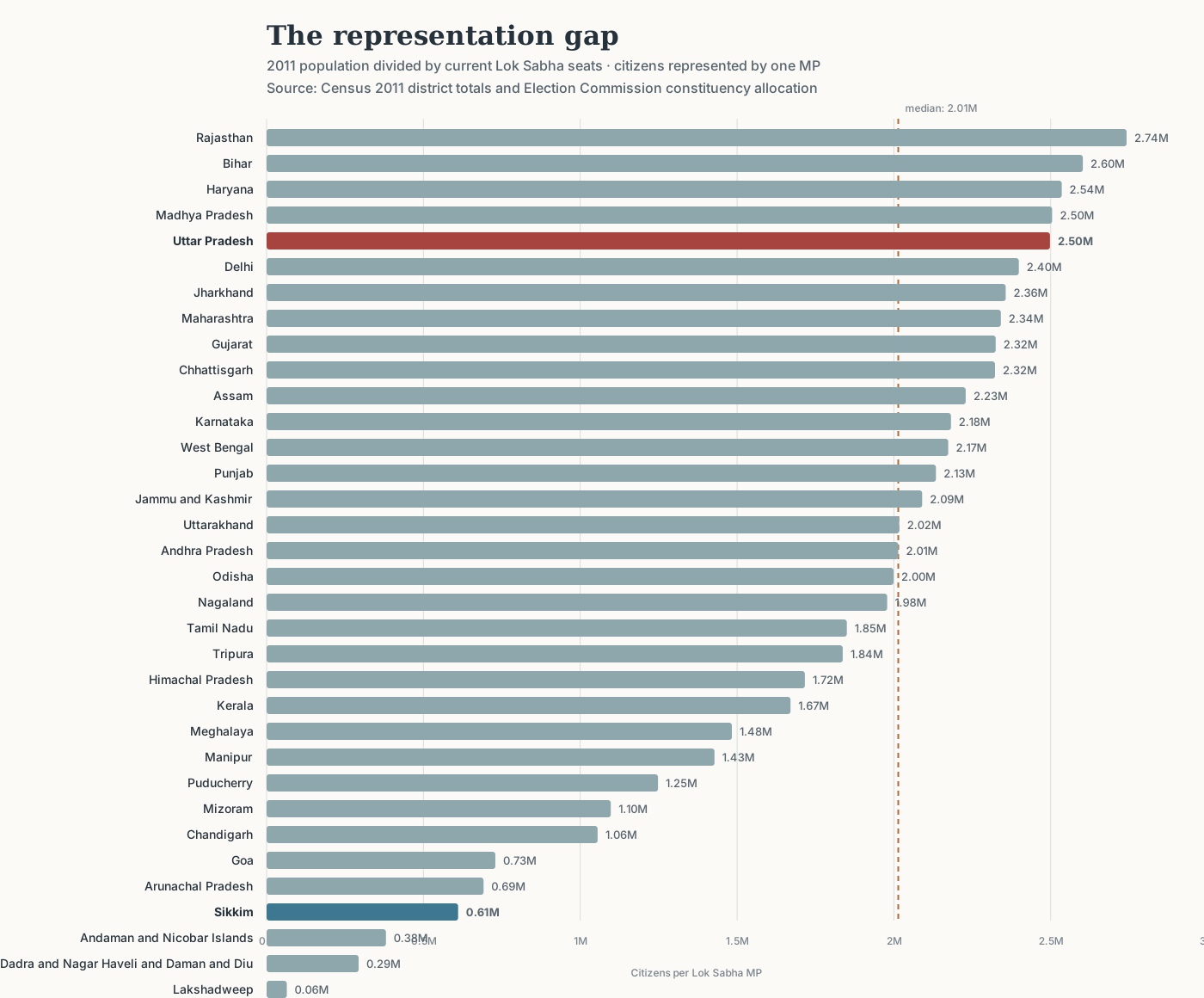
Figure 1: Citizens per Lok Sabha MP by state and union territory. Source: Census of India 2011; Lok Sabha Secretariat.
Part I: What the Rajya Sabha Was Supposed To Be
The Constituent Assembly's Compromise
On January 3, 1949, the Constituent Assembly debated Articles 66 and 67 — the provisions creating India's bicameral Parliament.[8] The debate reveals something the history books gloss over: the framers were deeply uncertain about what they were building.
Lokanath Misra (Orissa) moved to abolish the Council of States entirely:
"I do not think there is any real need for the second Chamber, nor do I think that it will serve any useful purpose... It is now admitted almost on all hands that second Chambers are out of date..."[8]
Misra was not isolated in his view. Orissa had already abolished its state-level upper house. He saw what others saw: the Rajya Sabha, as designed, functioned as a delaying chamber with limited purpose.
The defenders offered modest arguments. Ananthasayanam Ayyangar argued for it on two grounds:
"It is common knowledge that in this country... there is so much enthusiasm and if for no other reason, we must find opportunity for various people to take part in politics... Whatever hasty legislation is passed by the lower House may be checkmated by the go-slow movement of the Upper House."[8]
Notice what Ayyangar did NOT say: he did not argue that the Rajya Sabha would protect state interests against Centre encroachment. He did not claim it would give federal balance. His arguments were: (1) more political jobs, and (2) slowing legislation down. The federalism rationale was an afterthought.
The Union Constitution Committee under Nehru did recommend a two-chamber legislature "to represent the interests of the states." Ambedkar affirmed this role.[9] But the structure they created had no teeth to actually do the job.
K.T. Shah: The Voice That Was Ignored
Professor K.T. Shah was the Assembly's most persistent critic of weak democratic design. On the Rajya Sabha, he was devastating:
- He called indirect election "the worst system which maximises corruption" (quoting Harold Laski)[8]
- He called the nomination of members "undemocratic"[8]
- He wanted direct election for every office, from President to parliamentarian
Shah lost every vote. But his arguments expose the Assembly's underlying tension: stability versus democracy, party management versus federalism. The Rajya Sabha was created because it was familiar (the Government of India Act 1935 had one)[10] and politically convenient (more seats for Congress loyalists), not because anyone designed it to work.
Part II: What the Rajya Sabha Actually Became
The Anti-Federal Reality
Today's Rajya Sabha fails on every dimension that would make it a genuine federal chamber:
| Feature | What India Has | What Federalism Requires |
|---|---|---|
| Selection of members | Indirect election by MLAs (Art. 80)[3] + 12 presidential nominations for distinguished service (Art. 80(1)(a))[3] | Direct election by state citizens, OR state government ministers |
| State representation | Proportional to population (UP: 31, Sikkim: 1)[3] | Equal weight per state, OR weighted by some federal principle |
| Veto power | Can suggest amendments to non-money bills; money bills are exempt (Art. 109)[5] | Real veto on all legislation affecting states |
| Accountability | To party high command | To state electorate or state government |
The result is predictable. Rajya Sabha members represent parties, not states. They vote on party lines.[11] They are often parachuted into states they have never lived in.[12] The "Council of States" is a council of party appointees.
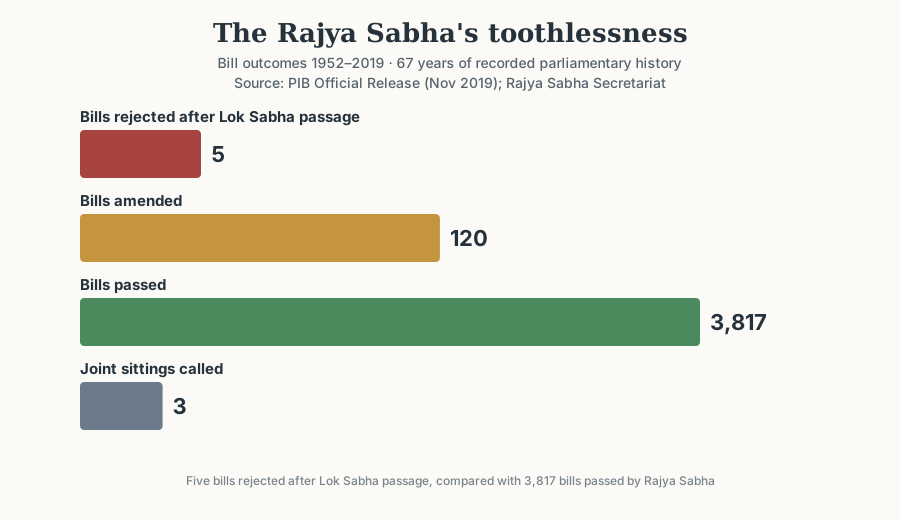
Figure 3: Rajya Sabha legislative output, 1952–2019. Five bills were rejected by the Rajya Sabha after first passing the Lok Sabha, compared with 3,817 bills passed by the upper house. Source: PIB and Rajya Sabha Secretariat.
The Parachute Candidate Problem
The Indian Constitution places no residency requirement on Lok Sabha candidates.[13] In the UK, a constituency link is an established political convention. In the US, Representatives must be inhabitants of the state they represent.[14] India has no comparable requirement.
But the deeper problem lies in the Rajya Sabha. The Representation of the People Act, 1951 originally required that a Rajya Sabha candidate be an elector in the state they sought to represent. In 2003, Parliament amended Section 3 of the Act, replacing "in that State" with "in India."[26] The Supreme Court upheld this change in Kuldip Nayar v. Union of India (2006), holding that "residence or domicile are not essential ingredients of the structure and composition of the Upper House."[27]
The result: a politician born in Punjab can represent Assam in the Rajya Sabha for 28 years. A former Prime Minister from Delhi can be elected from a state he has never lived in. The "Council of States" has no requirement that its members have any connection to the state that sends them.
Prominent examples:
| Politician | Home / Origin | Represented | House |
|---|---|---|---|
| Manmohan Singh | Punjab (born Gah, now Pakistan) | Assam (1991–2019); Rajasthan (2019–2024) | Rajya Sabha |
| Rahul Gandhi | Delhi / Uttar Pradesh | Wayanad, Kerala | Lok Sabha |
| Narendra Modi | Gujarat | Varanasi, Uttar Pradesh | Lok Sabha |
| P. Chidambaram | Tamil Nadu | Maharashtra (later Tamil Nadu) | Rajya Sabha |
| Nirmala Sitharaman | Tamil Nadu | Andhra Pradesh (2014); Karnataka (2016–) | Rajya Sabha |
| Kapil Sibal | Punjab | Bihar (1998); Uttar Pradesh (later) | Rajya Sabha |
| Suresh Prabhu | Maharashtra | Haryana (2014–2016); Andhra Pradesh (2016) | Rajya Sabha |
| Arun Jaitley | Delhi | Gujarat (2000–2018); Uttar Pradesh (2018) | Rajya Sabha |
| Jairam Ramesh | Karnataka | Andhra Pradesh (2004); Karnataka (2016–) | Rajya Sabha |
| Rajeev Shukla | Uttar Pradesh (Kanpur) | Chhattisgarh | Rajya Sabha |
The pattern is consistent across parties. The 2003 amendment removed the last formal barrier, and the practice has only accelerated. In a genuine federal system, this would be unthinkable: a German Bundesrat member must be a minister of the state government they represent. An Australian Senator must be elected by the people of their state. India's upper house has no such requirement — and therefore no such legitimacy.
The Rajya Sabha as Retirement Home
The nomination system makes it worse. Twelve members are appointed by the President for "special knowledge or practical experience" in literature, science, art, or social service.[3] In theory, this brings expertise. In practice, it brings cronyism.[15]
More tellingly, the indirectly elected members are often defeated Lok Sabha MPs rewarded with a back door to Parliament. Or businessmen who funded the party. Or loyalists who could not win a direct election. The Rajya Sabha has become India's House of Lords — without even the British pretense of hereditary dignity.
Part III: The Global Alternatives
The US Senate: Equal and Elected
The US Constitutional Convention nearly collapsed because small states refused to join a union where Virginia and Pennsylvania would dominate. The Connecticut Compromise solved it: equal state representation in the Senate (2 per state), proportional in the House.[7]
Key features India never adopted:
- Direct election since 1913 (17th Amendment)[16] — no nominations, no appointments
- Equal weight per state — Wyoming (577,000) and California (39 million) both get 2 Senators.[17] This intentionally overweights smaller/rural states to prevent urban coastal dominance
- Real power: Confirms cabinet appointments, Supreme Court justices, treaties. Can block all legislation. The filibuster means 41 Senators can stop most bills[7]
- Staggered terms: 6-year terms, one-third up every 2 years — insulates from sudden populist waves[7]
The US Senate is undemocratic by design — and that is the point. It forces national majorities to negotiate with geographic minorities.[18]
The German Bundesrat: States at the Table
Germany's upper house is arguably the most powerful in the world because of one simple design choice: state governments sit in it.[4]
- Delegates are proportional to population (Bayern sends 6, Bremen sends 3), but they must vote as a bloc according to the state cabinet's instructions[4]
- Absolute veto on any legislation affecting state powers, finances, or administration — roughly 40–50% of all federal bills[4]
- The Bundesrat cannot bring down the government, but it can block legislation indefinitely
- The critical difference from India: state governments control the delegates
The Australian Senate: Westminster Meets Federalism
Australia copied the US model but added its own innovations:
- 12 Senators per state regardless of population. Tasmania (572,000) and New South Wales (8.2 million) have equal delegations[19]
- Preferential voting — not FPTP, so minor parties and independents regularly win seats. The "crossbench" often holds the balance of power
- Double dissolution: If the Senate blocks a bill twice, both houses are dissolved and fresh elections called. Used 7 times in 120 years[20]
- Real power: Has rejected or amended government bills thousands of times
Australia proves that equal state representation works in a Westminster-derived system. You do not need to copy the US presidential model wholesale.

Figure 6: Population ratio between the largest and smallest state in four federal democracies, annotated with upper-house veto power and member selection method. Sources: US Census Bureau 2023; Australian Bureau of Statistics 2024; Statistisches Bundesamt 2024; Census of India 2011.
| Feature | United States | Germany | Australia | India |
|---|---|---|---|---|
| Upper house | Senate | Bundesrat | Senate | Rajya Sabha |
| Seats per small state | 2 (Wyoming) | 3 (Bremen) | 12 (Tasmania) | 1 (Sikkim) |
| Seats per large state | 2 (California) | 6 (Bavaria) | 12 (New South Wales) | 31 (Uttar Pradesh) |
| Population ratio | 67 : 1 | 19 : 1 | 14 : 1 | 327 : 1 |
| Selection | Direct election | State ministers | Direct election (STV) | Indirect (MLAs) |
| Veto power | Absolute | Absolute (state bills) | Can block + double dissolution | Delay only |
Part IV: Objections to an American-Style Senate — And Why They Fail
Objection 1: "Extreme Democratic Deficit"
The argument: In the 2011 Census, Sikkim had 610,577 people and Uttar Pradesh 199.8 million — a ratio of roughly 327:1.[6] Under equal state representation, a Sikkimese voter would have more than 300 times the Senate representation of a voter in Uttar Pradesh. Even democratic theorists who accept geographic weighting question this extreme.
The response: This objection conflates democratic equality with the functional requirements of a federation. The US founders explicitly rejected pure majoritarianism. The point was never to make every vote equal — it was to make every state equal in the federal compact.[18]
India faces a structural challenge that the US did not: the demographic weight of the Hindi belt threatens to override federalism with majoritarianism. Uttar Pradesh currently holds 80 of 543 Lok Sabha seats, or 14.7%; population-based projections would raise that share toward 17%.[21] A US-style Senate is not undemocratic — it is anti-majoritarian by design, and that design addresses India's particular challenge.
Moreover, Germany's Bundesrat avoids the extreme ratio by weighting delegates by population while maintaining state control.[4] India could adopt a hybrid: equal Senate representation (say, 6 per state) with direct election, avoiding both the extreme population ratio and Sikkim's limited weight in the Lok Sabha.
Objection 2: "It Won't Help Progressive States"
The argument: Equal representation would empower Northeastern states (Arunachal, Nagaland) and small Hindi belt states (Uttarakhand, Himachal) alongside Kerala and Tamil Nadu. The "progressive South" narrative doesn't survive equal representation.
The response: This objection misidentifies the purpose of federalism. The goal is not to empower "progressive" states against "regressive" ones. The argument is structural: smaller and peripheral states must have a meaningful voice, or the Union faces centrifugal pressure.
The divergence between UP and Kerala is not merely cultural — it is fiscal, administrative, and political. Kerala invests in education and health; UP does not. Kerala's literacy rate (93%) and life expectancy (74 years) approach Eastern European levels; UP's (68% literacy, 65 years) are comparable to the least developed countries.[22][23] If the Lok Sabha alone governs India, UP's demographic weight may permanently override Kerala's developmental model. A Senate gives Kerala (and every other small state) a veto on policies that would weaken the Union's weakest members.
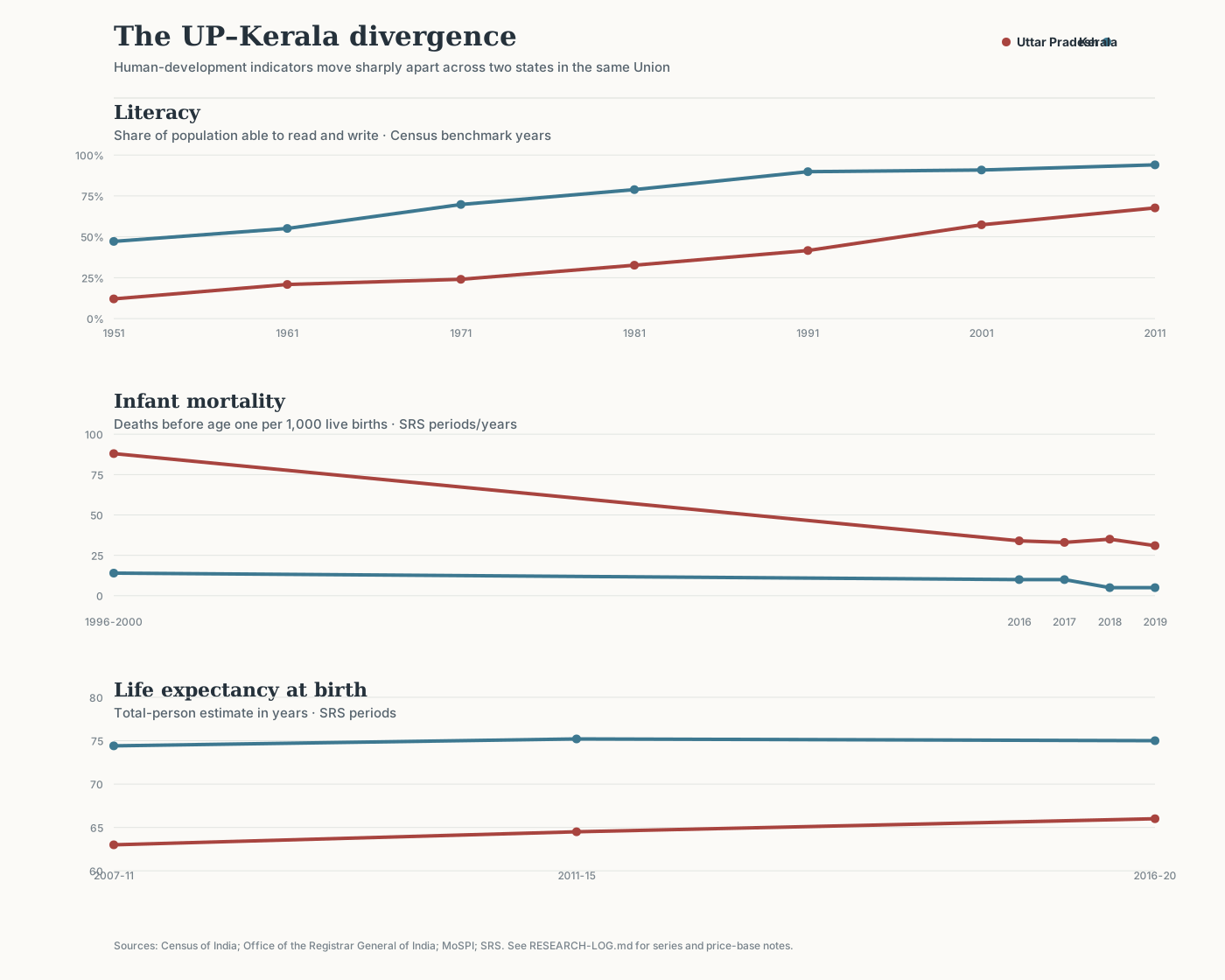
Figure 2: Development divergence between Uttar Pradesh and Kerala. Literacy: Census of India 2011; Infant Mortality Rate: SRS Bulletin 2018; Life Expectancy: SRS 2013–17; NSDP per capita: RBI 2017–18.
The Northeastern states should have more power. They are India's most neglected region, with infrastructure, governance, and integration challenges that the Centre has failed for 75 years. Giving them Senate seats is not an error — it is a feature of genuine federalism.
Objection 3: "Parliamentary System Incompatibility"
The argument: In a parliamentary system, a powerful upper house creates deadlock. If the Senate blocks the budget, the government falls. Australia's double dissolution is politically nuclear and rarely used.
The response: This is the strongest objection — and the answer is constitutional design, not avoidance. Australia's double dissolution works precisely because it is rare and politically costly. India could adopt a similar mechanism: if the Senate blocks a money bill twice, both houses face fresh elections. The threat alone would force negotiation.
Alternatively, India could adopt Germany's model: the Senate has absolute veto on state-affecting legislation but cannot bring down the government. This separates the budget (government survival) from federal legislation (state interests), avoiding the parliamentary no-confidence paradox.
The objection assumes India's current parliamentary system is sacrosanct. It is not. The Constitution has been amended 106 times. If the system cannot accommodate federalism, the system — not federalism — is the problem.
Objection 4: "Direct Election Duplicates Populism"
The argument: The US Senate became more partisan after the 17th Amendment (direct election, 1913). A directly elected Indian Senate might just become Lok Sabha-2, with the same party structures and populist pressures.
The response: This risk is real but manageable. Australia's preferential voting system (not FPTP) allows minor parties and independents to win Senate seats, creating a genuine crossbench. India could adopt proportional representation or a single transferable vote for Senate elections — systems that would break the BJP/INC duopoly in the upper house.
More fundamentally: the current Rajya Sabha is ALREADY captured by parties. At least direct election would make Senators accountable to someone other than the party president.
Objection 5: "Identity, Not State, Is the Real Cleavage"
The argument: India's deepest inequality is intra-state (caste, not geography). A Brahmin in UP and a Dalit in UP have more divergent interests than a Brahmin in UP and a Brahmin in Kerala. Geographic federalism doesn't address caste-based power asymmetries.
The response: This is a misleading objection. It treats identity politics and geographic federalism as mutually exclusive, when they are in fact complementary.
Identity-based minority protection — reservations, separate electorates, religion-specific legislation — has been India's path to sectarian democracy. It permanently divides citizens into categories and pits them against each other. The Constituent Assembly rejected separate electorates for this exact reason. Ambedkar himself moved from separate electorates to joint electorates with reserved seats precisely because he recognized that identity-based political structures fragment democratic citizenship.
Geographic federalism, by contrast, creates cross-cutting cleavages. A Tamil Senator represents Tamils of all castes. A Kerala Senator represents Malayalis of all religions. This is not a weakness — it is the foundation of a shared civic identity.
The "caste is the real cleavage" argument, taken to its logical conclusion, justifies every form of communal and sectarian politics India has suffered. Federalism is the alternative.
Part V: What an Indian Senate Would Look Like
The Design
Here is a concrete proposal:
1. Equal State Representation
- 6 Senators per state, regardless of population
- 2 per Union Territory with legislature (Delhi, Puducherry, J&K)
- Total: 174 Senators, assuming two seats for each of Delhi, Puducherry, and Jammu and Kashmir
2. Direct Election via Single Transferable Vote
- Each state elects 6 Senators through STV, with two seats contested every two years
- Voters rank candidates; proportional representation ensures diverse outcomes
- Staggered terms: 2 Senators per state every 2 years, 6-year total term
3. Real Federal Veto
- Absolute veto on all legislation affecting state subjects, state finances, or Centre-state relations
- Suspensive veto (delay only) on money bills — after 3 months, Lok Sabha can override with simple majority
- No veto on pure national matters (defense, foreign policy, currency)
4. State Residency Requirement
- Candidates must have been residents of the state for at least 5 years
- Ends the parachute candidate problem; ensures Senators actually represent their state
5. Double Dissolution
- If Senate blocks the same bill twice with >60% support, President may dissolve both houses for fresh elections
- Rarely invoked, but forces negotiation
Why This Works
The Lok Sabha remains as the directly representative, population-proportional house. It controls the government, initiates money bills, and reflects the will of the national majority. Nothing about this proposal weakens the Lok Sabha.
The Senate becomes a genuine federal chamber. It protects state interests, forces national majorities to negotiate, and gives peripheral states a permanent voice. It is not a delaying chamber — it is a veto point.
The combination mirrors the US, Australian, and German models adapted to India's scale. It preserves parliamentary government while adding federal teeth.
Part VI: The Long View — Why Federalism Is Necessary
India's most persistent long-term challenge is internal fragmentation driven by the dominance of a few large states over the many small ones.
The divergence between UP and Kerala is not temporary. It is structural, deepening, and likely irreversible under current arrangements. UP's population will continue to grow; Kerala's has stabilized.[24] UP's representation in the Lok Sabha will increase; Kerala's will shrink.[25] If the only house that matters is population-proportional, Kerala's developmental model may be permanently overridden by UP's demographic weight.
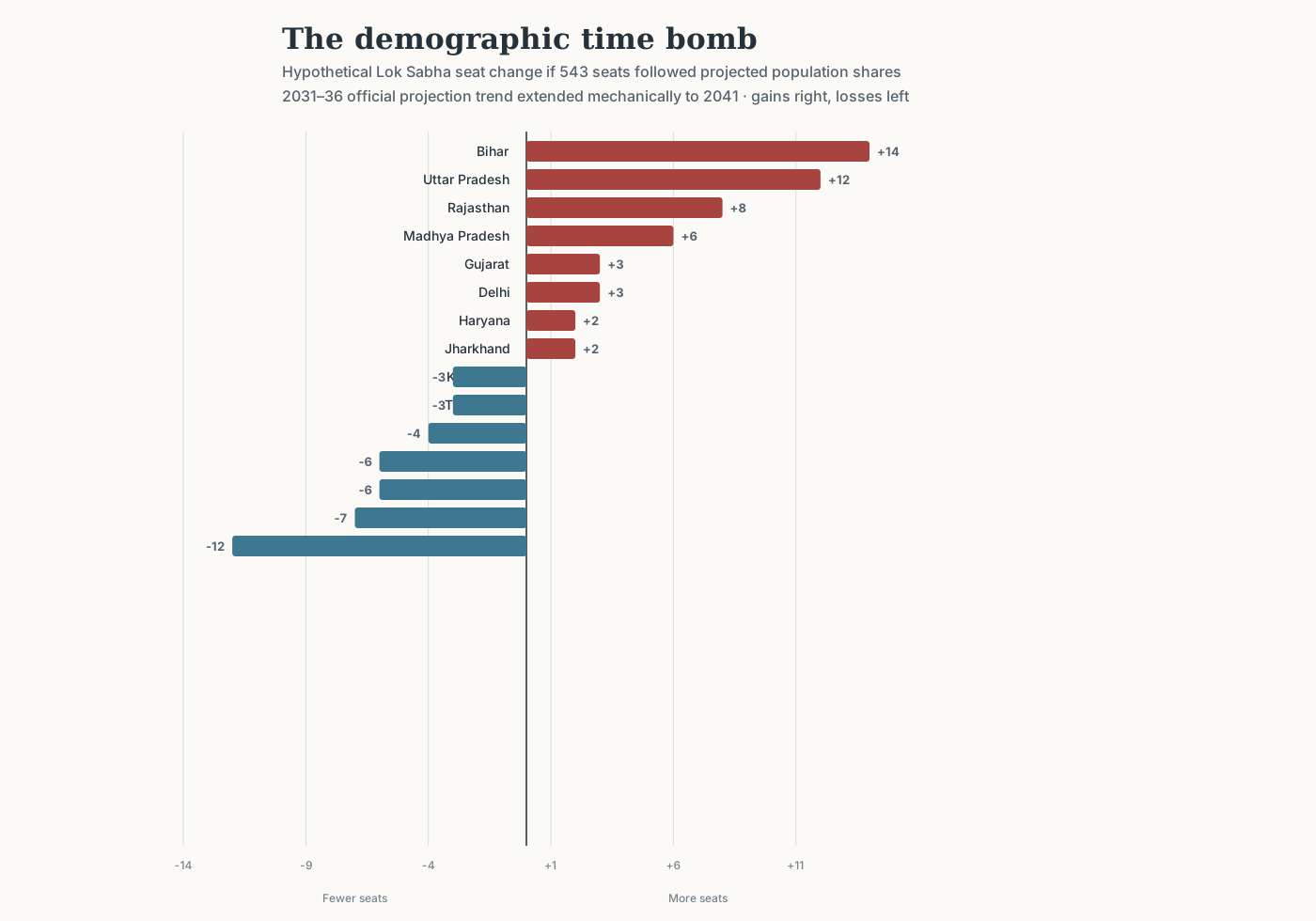
Figure 4: A reapportionment thought experiment using official 2031 and 2036 population projections,[29] mechanically extended to 2041. The 2041 values are a scenario, not an official forecast; current total is held at 543 seats. Full method and data: provenance note.
This is not hypothetical. The Hindi belt's political dominance already shapes national education policy, health funding, language policy, and cultural norms. Smaller states have no structural mechanism to resist.
The fiscal dimension is equally stark. The 16th Finance Commission (2026–31) slightly reduced the shares of Uttar Pradesh, Bihar, Madhya Pradesh, Rajasthan, and West Bengal while increasing the shares of Karnataka, Kerala, Gujarat, Maharashtra, and Andhra Pradesh.[28] That pattern is consistent with fiscal equalisation: poorer states receive more than their population or tax base alone would imply. But it also creates a political asymmetry. The states that generate more economic activity do not control the formula that redistributes their share of the divisible pool. A genuine federal upper house would give states a structured voice over that bargain.
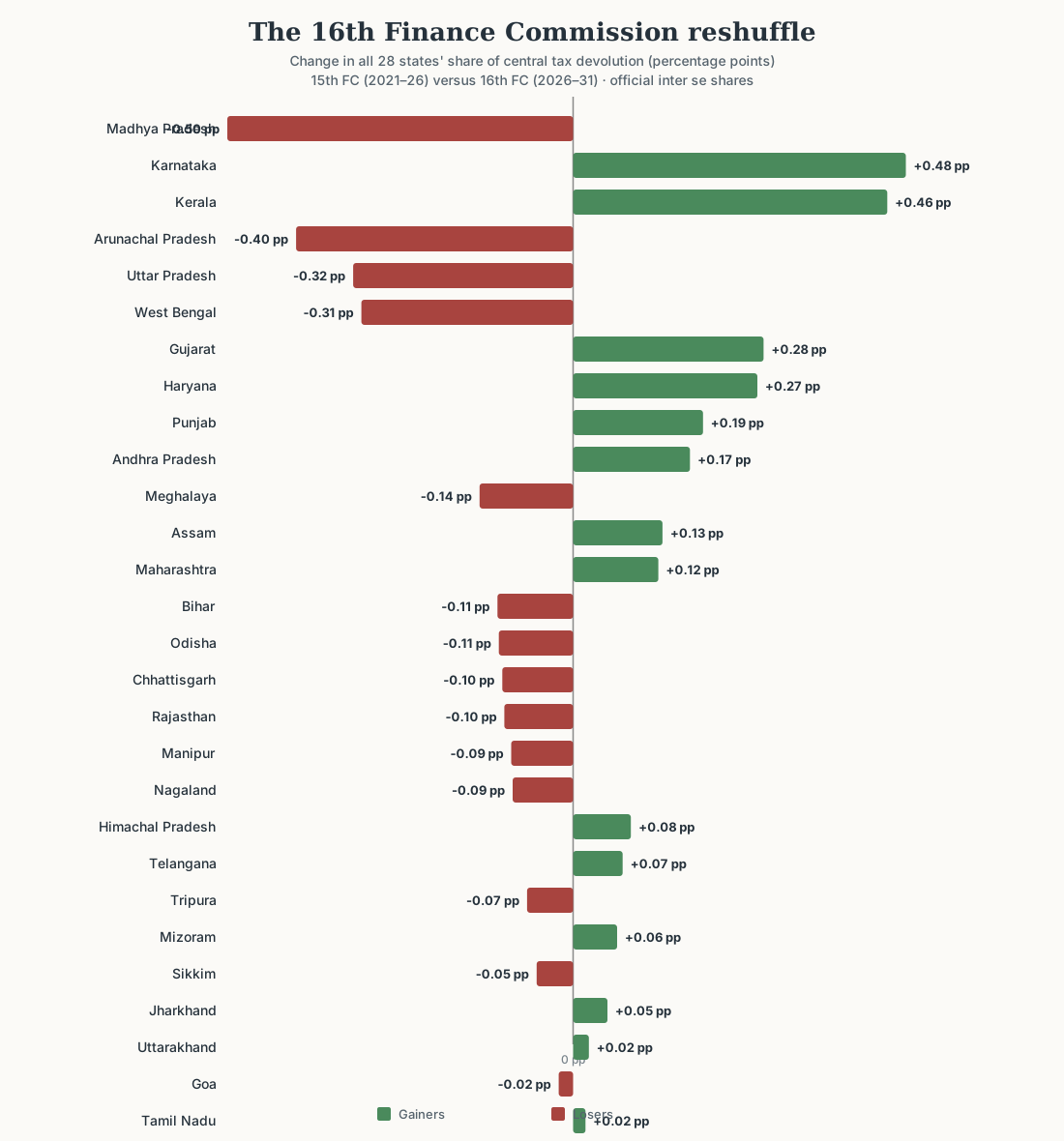
Figure 5: Change in all 28 states' share of central tax devolution between the 15th and 16th Finance Commissions. This is a change in formula shares, not a measure of net tax contribution or total transfers. Source: official 15th and 16th Finance Commission reports.
The US founders understood this. They knew that pure majoritarianism in a large, diverse republic would strain the union. They built the Senate as a counterweight — undemocratic in isolation, but essential for federation.
India faces the same choice. The Rajya Sabha, as currently designed, cannot do the job. It was never designed to. The Constituent Assembly compromised, deferred, and imitated — and 75 years later, the consequences are visible.
The choice is not between reform and status quo. The status quo is unsustainable. The choice is between genuine federal redesign and the gradual erosion of the Union into majoritarian centralism.
The Senate is not optional. It is structurally necessary.
References
- Election Commission of India, "General Elections to Lok Sabha 2019: Statistical Report" and "General Elections to Lok Sabha 2024." India conducts the world's largest democratic exercise, with 968 million registered electors in 2024. https://eci.gov.in/
- Article 84, Constitution of India, read with the Representation of the People Act, 1951. The Constitution sets age and citizenship qualifications for Lok Sabha membership but imposes no residency or domicile requirement for the constituency contested. https://legislative.gov.in/constitution-of-india/
- Article 80, Constitution of India. The Rajya Sabha has a maximum strength of 250: 238 representatives of states and Union Territories (elected by MLAs under the system of proportional representation by single transferable vote) and 12 members nominated by the President for distinguished service in literature, science, art, or social service. Seats among states are allocated proportionally to population (Census 1971 basis, frozen until 2026 by the 42nd and 84th Amendments). https://legislative.gov.in/constitution-of-india/
- German Basic Law, Articles 50–53. The Bundesrat consists of members of state governments (Art. 51), votes as a bloc on state cabinet instructions, and has absolute veto on legislation affecting state administration, finances, or the constitutional order of the Länder (Art. 77). See also Steuerzahlerbund v. Hamburg, BVerfGE 109, 148 (2004) on the scope of the Bundesrat veto. https://www.gesetze-im-internet.de/gg/
- Article 109, Constitution of India. A money bill (defined in Art. 110) can be introduced only in the Lok Sabha. The Rajya Sabha may return it with recommendations within 14 days, but the Lok Sabha may reject all recommendations. Art. 110(3): if the Speaker certifies a bill as a money bill, that certification is final. https://legislative.gov.in/constitution-of-india/
- Census of India 2011, Office of the Registrar General & Census Commissioner. Uttar Pradesh: 199.8 million; Sikkim: 610,577. Lok Sabha seat allocation (frozen at 1971 Census levels until 2026): UP 80 seats, Sikkim 1 seat. See also Delimitation Commission of India, "Delimitation of Parliamentary and Assembly Constituencies Order, 2008." https://censusindia.gov.in/
- US Constitution, Article I, Section 3. "The Senate of the United States shall be composed of two Senators from each State..." The 17th Amendment (1913) provided for direct election; staggered six-year terms with one-third rotating every two years are specified in Clause 2. https://www.congress.gov/
- Constituent Assembly Debates, Volume VII (10 December 1948, 13 December 1948, 30 December 1948, 3 January 1949). Lok Sabha Digital Library. The debates on Articles 66 and 67 record Lokanath Misra's motion to abolish the Council of States, Ananthasayanam Ayyangar's defence, and K.T. Shah's repeated objections to indirect election and nomination. https://loksabhadocs.nic.in/
- Granville Austin, The Indian Constitution: Cornerstone of a Nation (Oxford University Press, 1966), pp. 156–162. Documents the Union Constitution Committee's recommendation for a bicameral legislature "to represent the interests of the states" and Ambedkar's defence of the Rajya Sabha in the drafting committee.
- Government of India Act 1935, Part IV, Chapter II. Established a Federal Legislature with a Council of State (upper house) and Federal Assembly (lower house). The 1935 structure was the direct template for the Rajya Sabha's design. See also P.B. Mukharji, The Constitutional History of India (K.L. Mukhopadhyay, 1970).
- PRS Legislative Research, "Rajya Sabha: Attendance and Participation." Analysis of recorded votes shows that Rajya Sabha members vote overwhelmingly along party lines; cross-voting is rare and typically punished by disqualification under the Tenth Schedule. https://prsindia.org/
- Shri Prakash, "Rajya Sabha and the Decline of Federalism," Mainstream 56(8) (2018). Documents the practice of "outsider" candidatures — Rajya Sabha members elected from states where they have no prior political or residential connection. See also Ronojoy Sen, House Matters: The BJP, Modi and the Lok Sabha (Oxford University Press, 2022) on the strategic use of Rajya Sabha nominations.
- Article 84, Constitution of India. Qualifications for membership of Parliament: (a) citizen of India; (b) 25 years of age for Lok Sabha / 30 for Rajya Sabha; (c) registered elector in any parliamentary constituency. No domicile or prior residency requirement exists. Contrast with Article I, Section 2 of the US Constitution: Representatives must "be an Inhabitant of that State in which he shall be chosen."
- US Constitution, Article I, Section 2. Representatives must be at least 25 years old, citizens for 7 years, and "when elected, be an Inhabitant of that State in which he shall be chosen." The Supreme Court has held that Congress may not add further qualifications (U.S. Term Limits, Inc. v. Thornton, 514 U.S. 779 (1995)).
- PRS Legislative Research, "Analysis of Rajya Sabha Nominated Members." Examines the backgrounds of the 12 nominated members since 1952; notes a shift from genuine expertise (scientists, artists) toward political patronage and party funding connections in recent decades. https://prsindia.org/
- Seventeenth Amendment to the US Constitution (ratified 8 April 1913). Provided that Senators "shall be elected by the people" of each state, replacing the original provision (Art. I, §3, Cl. 1) for election by state legislatures. See also Caperton v. A.T. Massey Coal Co., 556 U.S. 868 (2009) on judicial review of state electoral processes.
- US Census Bureau, "QuickFacts: Wyoming; California." 2023 estimates: Wyoming 584,057; California 38,965,193. The ratio is approximately 67:1. Both states elect 2 Senators. https://www.census.gov/quickfacts/
- The Federalist Papers, No. 62 (James Madison): "The qualifications proposed for senators... are such as to give a reasonable preference to those who... are most distinguished by their abilities and virtue." No. 63 (Madison or Hamilton): the Senate as a defence against "the infection of violent passions" and "the operations of improper and interested combinations." https://guides.loc.gov/federalist-papers/
- Australian Constitution, Sections 7 and 13. Section 7: "The Senate shall be composed of senators for each State, directly chosen by the people of the State, voting, until the Parliament otherwise provides, as one electorate." Section 13: rotation of Senators (half every three years; full term six years). See also Australian Bureau of Statistics, "National, state and territory population, March 2024." Tasmania: 572,780; NSW: 8,238,801. https://www.aph.gov.au/
- Australian Parliament, "Double Dissolution." Seven double dissolutions have been triggered since Federation (1901): 1914, 1951, 1974, 1975, 1983, 1987, and 2016. The mechanism is set out in Section 57 of the Australian Constitution. https://www.aph.gov.au/
- Lok Sabha Secretariat, "Strength of Lok Sabha." Uttar Pradesh: 80 seats out of 543 (14.7% as of current allocation, frozen at 1971 Census levels). Projections based on 2011 Census suggest UP would gain approximately 10–12 additional seats if delimitation were conducted on current population, giving it close to 17% of the total. https://loksabha.nic.in/
- Census of India 2011, "Literacy Rate" (Table C-1): Kerala 93.91%, Uttar Pradesh 67.68%. Office of the Registrar General, "Sample Registration System (SRS) Statistical Report 2013–17": Kerala life expectancy at birth 74.9 years (2013–17), Uttar Pradesh 64.1 years. https://censusindia.gov.in/
- UNDP, "Human Development Report 2019." Kerala HDI: 0.779 (comparable to Bosnia and Herzegovina, 0.779); Uttar Pradesh HDI: 0.596 (comparable to Angola, 0.574–0.595 range). India's national HDI: 0.647. See also Government of India, "National Family Health Survey (NFHS-5) 2019–21" for health and nutrition indicators. https://hdr.undp.org/
- Office of the Registrar General, "Sample Registration System Statistical Report 2020" and "Report on India and Larger States" (2019). Total Fertility Rate 2020: Uttar Pradesh 2.4 (above replacement), Kerala 1.8 (well below replacement). SRS data since 1971 confirms divergent demographic trajectories. https://censusindia.gov.in/
- Article 82, Constitution of India, read with the Forty-Second Amendment Act, 1976 (freezing Lok Sabha seats at 1971 Census levels until 2001) and the Eighty-Fourth Amendment Act, 2001 (extending the freeze to 2026). The next delimitation, due after 2026, will likely increase UP's seat share significantly given population growth since 1971. See also Delimitation Commission, "Report on Delimitation of Constituencies, 1976."
- Representation of the People (Amendment) Act, 2003 (Act 40 of 2003). Amended Section 3 of the Representation of the People Act, 1951, replacing the phrase "in that State or territory" with "in India," thereby removing the requirement that a Rajya Sabha candidate be an elector in the state they seek to represent. See also PRS Legislative Research, "The Representation of the People (Amendment) Bill, 2003." https://prsindia.org/
- Kuldip Nayar v. Union of India, (2006) 7 SCC 1. The Supreme Court upheld the constitutional validity of the 2003 amendment, holding that "residence or domicile are not essential ingredients of the structure and composition of the Upper House" and that the Rajya Sabha is not required to represent states in the same manner as the German Bundesrat. https://indiankanoon.org/doc/681462/
- Fifteenth Finance Commission, Report for 2021–26, Table 6.5, and Sixteenth Finance Commission, Report for 2026–31, Chapter 8, Tables 8.8–8.9. The 16th FC changes the horizontal formula to population (2011) 17.5%, demographic performance 10%, area 10%, forest 10%, per-capita GSDP distance 42.5%, and contribution to GDP 10%. The combined share of Andhra Pradesh, Karnataka, Kerala, Tamil Nadu, and Telangana rises from 15.800% under the 15th FC to 17.001% under the 16th FC. These are inter se shares of the divisible pool, not measures of each state's net tax contribution or total transfers. 15th FC report; 16th FC report.
- National Commission on Population, Ministry of Health & Family Welfare, Report of the Technical Group on Population Projections for India and States 2011–2036 (July 2020), reproduced in National Health Profile 2023, Demographic Indicators, pp. 16–17. The report provides the official 2031 and 2036 state/UT population projections used in Figure 4. https://www.mohfw.gov.in/?q=reports-0
Additional Reading
- Madhav Khosla, India's Founding Moment: The Constitution of a Most Surprising Democracy (Harvard University Press, 2020) — On the Constituent Assembly's federalism debates.
- Madhusudan Mohanty, "Constituent Assembly Debates on Federalism," Indian Journal of Political Science 52(3) (1991) — Analysis of the Assembly's limited engagement with federal design.
- K.T. Shah's speeches in the Constituent Assembly — archived at constitutionofindia.net
- George Tsebelis & Jeannette Money, Bicameralism (Cambridge University Press, 1997) — Comparative theory of upper houses and veto power.
- Susan Rose-Ackerman, Diane A. Desierto & Natalia Volosin, "Hyper-Presidentialism: Separation of Powers without Checks and Balances in Argentina and Philippines," Berkeley Journal of International Law 29(1) (2011) — On the risks of weak bicameralism in presidential systems (analogous risks apply to parliamentary centralism).
This article was published by the Citizens' Justice Project (CJP). CJP is a non-partisan civic education initiative. Our analysis section publishes opinion, investigation, and polemic — grounded in data, open to correction.